Dowsing made simple
Ask. Swing. Know.
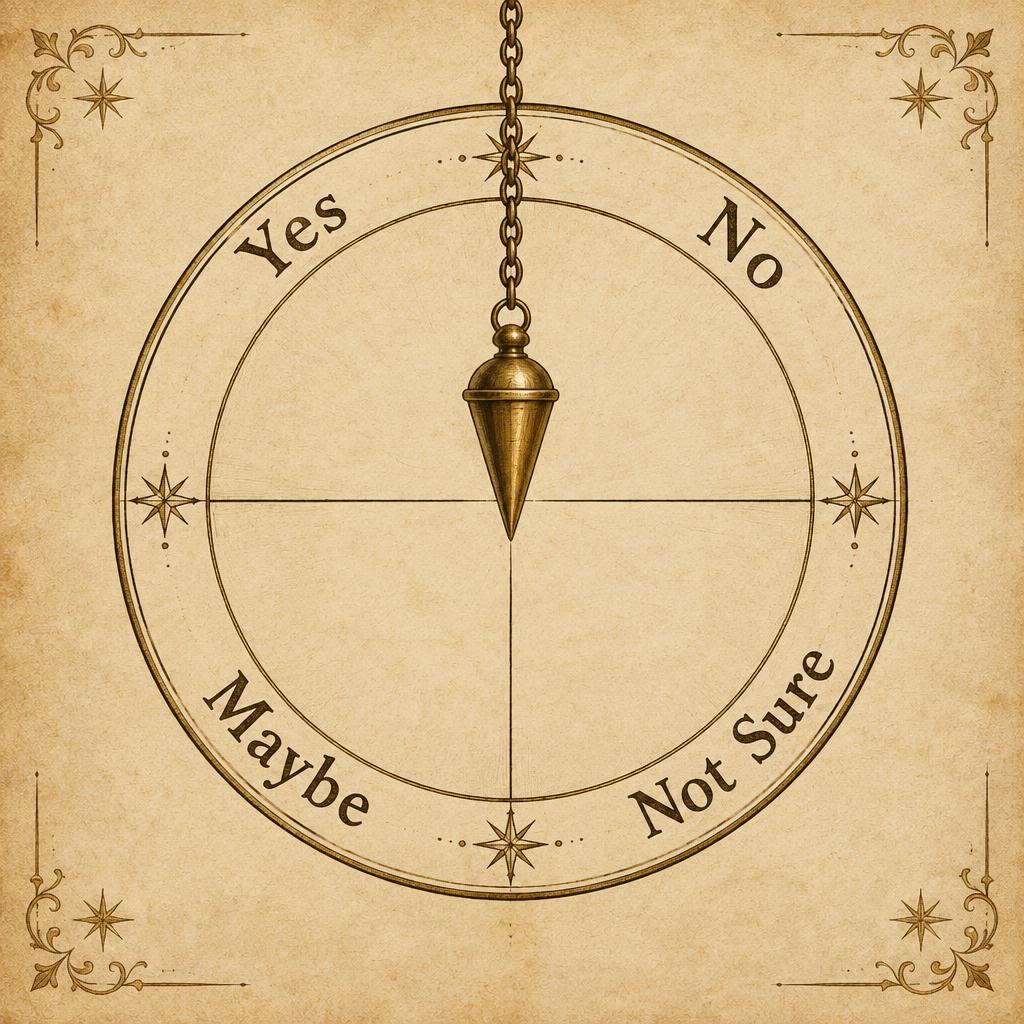
Beautifully crafted pendulum charts for dowsing — from the classic Yes/No circle to alphabet, number, and percentage layouts. Print them, use them, trust your swing.
A practice thousands of years old
Rooted in ancient history
Pendulum dowsing grew out of the same long tradition as hypnosis — the art of asking the unconscious mind directly. From the healing temples of ancient Egypt to the consulting rooms of modern hypnotherapy, seekers have used trance and simple tools to surface answers the conscious mind can't reach.
Ancient Egypt & India
Healing trance and divination practices appear in some of humanity's earliest records — sleep temples, ritual suggestion, and tools for seeking hidden answers.
1500s — Paracelsus
The Swiss physician Paracelsus explores healing with magnets, laying early groundwork for the idea of an unseen influence between healer and patient.
1750 — Franz Anton Mesmer
Mesmer introduces 'Mesmerism' in Vienna, popularizing trance healing across Europe — the practice that would become modern hypnosis.
1840s — James Braid
Scottish surgeon James Braid coins the term 'hypnosis' and reframes trance as a natural state of focused attention, not magic.
1860s — The Nancy School
Liébault and Bernheim in France establish that suggestion itself — not magnets or forces — is what moves the mind.
1900s — Milton Erickson
Erickson pioneers modern indirect hypnosis, teaching that the unconscious mind already holds the answers — the same principle behind pendulum work.
How it works
Three simple steps between you and your answer.
Step 1
Choose a chart
Pick the layout that fits your question — Yes/No, Maybe/Not Sure, letters, numbers, or percentages.
Step 2
Calibrate your pendulum
Hold the pendulum over the center and let it show you its swing for each answer before you ask.
Step 3
Ask and observe
Ask a clear question and watch which direction the pendulum swings — that's your answer.
The chart collection
A growing library of layouts for every kind of question.
Yes / No
The essential two-answer chart for quick decisions.
Yes / No / Maybe / Not Sure
Four quadrants for nuanced questions.
Alphabet
Spell out names, places, and words letter by letter.
Numbers 0–9
Dates, quantities, and numerical answers.
Percentage
Gauge likelihood, compatibility, or progress.
Chakra
Check energy balance across the seven chakras.
Common questions
What is a pendulum chart?
A pendulum chart is a printed diagram used in dowsing. You hold a pendulum over the chart, ask a question, and interpret the direction of its swing using the answers printed on the chart.
Do I need a special pendulum?
No. Any weighted object on a chain or string works — a crystal, a brass bob, even a ring. What matters is that it swings freely and feels comfortable in your hand.
Can I print the charts?
Yes. Every chart is designed to print cleanly on standard paper so you can keep it with your pendulum or in your journal.